
Which site would you like to visit?
By clicking the retail or wholesale site button and/or using rarewineco.com you are choosing to accept our use of cookies to provide you the best possible web experience.
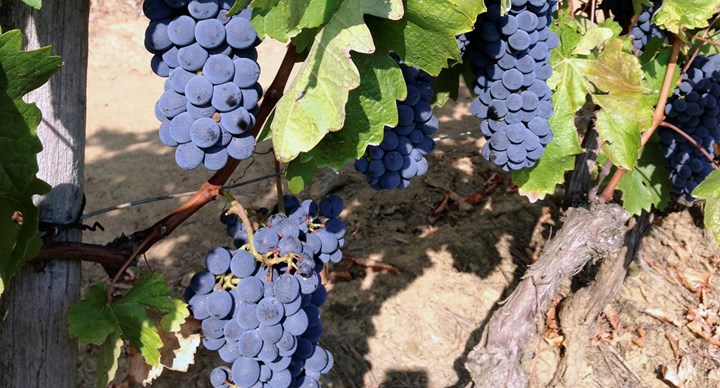
As a summer sipper, Moscato is without peers. And with more Americans discovering its extraordinary lusciousness, vivid fruit, soft mousse and captivating perfume, it is no surprise that the following for Moscato d’Asti has grown dramatically.
Ambrosial with the classic pairing of melon and prosciutto, it is a versatile aperitif wine that’s perfect with orchard fruits (especially if the fruit has been steeped in Moscato beforehand!) and various amuse-bouche. It is also superb after dinner on its own or with a light dessert.
Yet because of its delicacy and its dependence on perfect balance, only a few producers have mastered the craft of great Moscato. One of them is Stefano Perrone who has quietly built a reputation as one of the region’s masters.
“When I want to drink Moscato, two names tower above the rest; Perrone and Saracco.”
-Antonio Galloni, Vinous Media
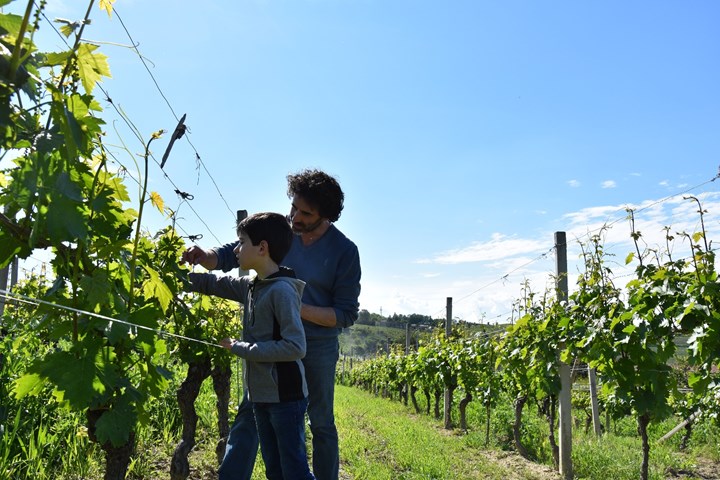
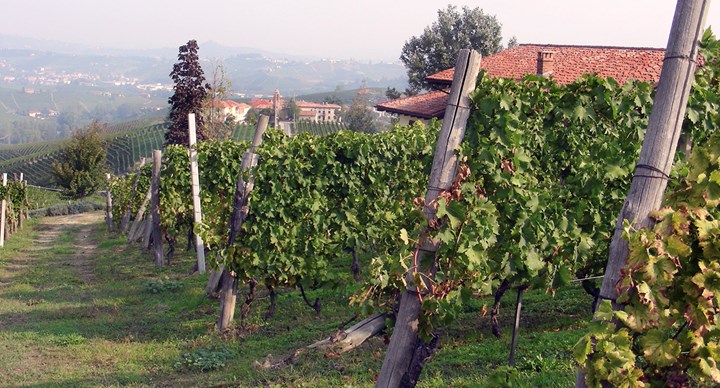
Stefano Perrone is descended from a long line of grape growers in Castiglione Tinella, the heart of Asti. He was an avid motocross racer, and eventually turned professional until an accident forced the end of that career. In his late-20s, he returned to the family vineyards and took up work with his father.
Stefano’s competitive edge drove him to wonder what more could be achieved with the family estate. He convinced his father to start making their own wine instead of selling grapes. And that energy drove him to make those wines ever better.
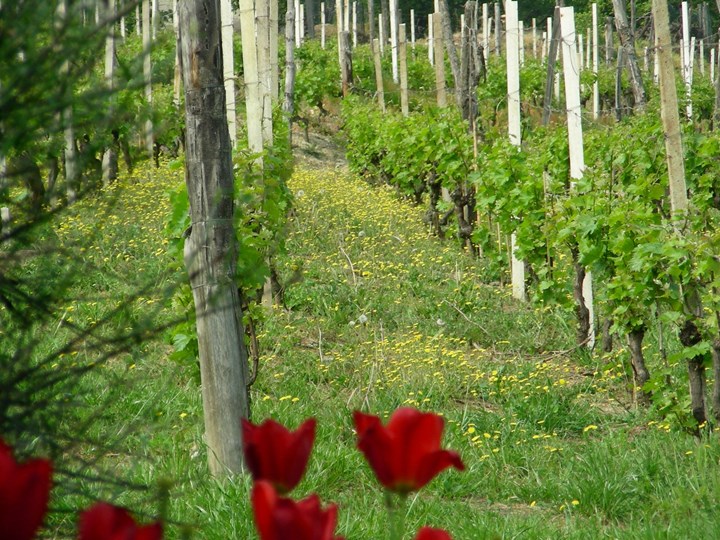
He began by pursuing lower yields and eliminating artificial fertilizers and pesticides in his vineyards. He focused on harvesting at just the right moment, always seeking to achieve greater freshness and balance in his wines.
Early on, he recognized that sweetness was easy to achieve in Moscato, but that balance and energy were the wine’s great challenge. He says that “Moscato should have the strength of a ballerina, and not a body builder,” and every step he takes is intended to yield that ideal.
With time, Stefano’s Moscato d’Asti “Sourgal” became one of the appellation’s premier wines, and yet he continued to seek out new challenges. An experiment with Brachetto proved unsatisfying, but it provoked Stefano to create his second great success, “Bigaro.”
Bigaro was an innovative blend of Brachetto and Moscato made in the Moscato d’Asti style. Made in Stefano’s elegant style, the wine quickly found a wide audience of its own.
While he was experimenting with Brachetto, Stefano also recognized that the Asti zone possessed many old Barbera vineyards. He purchased a spectacular south-facing site called Mongovone in Isola d’Asti, blessed with many vines approaching 100 years of age.
The oldest vines were set aside for an intense, limited-production Barbera that Stefano named Mongovone. But as large portions of the site required replanting, the new vines formed the basis for Stefano’s next triumph, Tasmorcan, highlighting Asti Barbera’s approachability and aromatic brilliance. (The name Tasmorcan is Piemontese dialect for its local badgers, who had an appetite for some of those early plantings.)
Our faith in Stefano has been rewarded by an unbroken string of sensational wines since we began working with him in 1995. His work has helped change how Americans view the Asti region’s sparkling wines for the better. Whether it’s another Moscato, Barbera, or something entirely new, we can hardly wait to see what marvels emerge from his cellar in the decades to come.
| Year | Description | Size | Notes | Avail/ Limit |
Price | |
|---|---|---|---|---|---|---|
| Please Call (415) 319-9000 for Availability | ||||||
New discoveries, rare bottles of extraordinary provenance, limited time offers delivered to your inbox weekly. Be the first to know.
Please Wait
Adding to Cart.
...Loading...
By clicking the retail or wholesale site button and/or using rarewineco.com you are choosing to accept our use of cookies to provide you the best possible web experience.